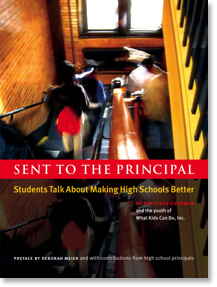
Students Talk About Making High Schools Better
by Kathleen Cushman and the students of What Kids Can Do
Foreword by Deborah Meier
August 2005 ♦ Hardcover ♦ 158 pages ♦ ISBN: 0-9762706-1-7 ♦ $19.95
 |
|
If you are a high school principal, your students want to have a word with you. They'd like to talk about those metal detectors, which suggest at the door that administrators expect teens to be armed. They'd like to explain how their course schedules seem to make assumptions about their futures, or how their clothing choices help them assert their cultural identities. They might simply want to have a con- versation in which you recognize them by name.
In a remarkable new guide for school leaders, over 65 students from this country's public schools shine a spotlight on central issues of school climate and culture. They offer insight on the issues that exert a largely unnoticed effect on how they learn and thrive. Sent to the Principal: Students Talk About Making High Schools Better gives a perspective often ignored in the policy world, but crucial in any effort to increase student engagement, motivation, and achievement.
Working with Kathleen Cushman (whose previous collaboration with teenagers, Fires in the Bathroom: Advice for Teachers from High School Students, struck a chord with classroom teachers nationwide), these students put forth a fresh angle on school improvement: They want adults to regard them as investment partners in their schooling, and treat them accordingly.
"If students knew when they woke up in the morning that what they had to say really mattered in what changes were made in the school—they would really come," says RaShawn, 17, who attends an overcrowded urban high school his district has labeled as failing. "It wouldn't just be an education that processes them, but one that they could affect and shape to benefit the student body."
Other students describe small signals that tell them whether their school expects them to succeed. They suggest ways to include their peers in routine decisions adults often make—about security, food, transportation, discipline—which affect their school experience. When they speak of matters that may seem purely practical, they link these back to the crucial issues of relationships between adults and young people. Students speak eloquently of the sense of investment and trust that follows when those relationships are strong and inclusive.
"The kid is a thread and the school is like a fabric, and you want to weave that kid into the fabric," says Adit, a senior at a large public high school in New York City. "You want to make it so that he has a vested interest in the dynamic of the school, and make him interested in, make him respect, the workings of the school, rather than see it as just another opportunity to show his defiance."
These students' central points—about cross-generation connections, personalized academic planning, respect for learning differences, shared decision-making—contain startling echoes of "Breaking Ranks II," a 2004 manifesto on improving high schools published by the National Association of Secondary School Principals. The book's contents page could serve as "a rubric for how well I do my job," noted Teri Schrader, one of several high school principals whose experiences are woven into Sent to the Principal.
Each chapter concludes with "Homework for Principals," a scenario that tests a school leader's sensitivity to the student viewpoint. For school leaders burdened with overwhelming schedules, these exercises underline a central message: Involving students is not one more thing to do, but another way of doing what you already do. It can lessen your work load, rather than increase it.
"It's easy for a principal to imagine that school improvement concerns the larger picture, not the individual lives of students," says Barbara Cervone, president of What Kids Can Do, Inc., the nonprofit that sponsored the book with support from MetLife Foundation. "But in fact, it's all about the small dots that create the big picture." Sent to the Principal presents that picture in powerful tones, from a rising generation with vital perspectives for school leaders to hear.
Click here to read praise from educators for Sent to the Principal.
Click here to download a PDF of early excerpts.