What is unique about Next Generation Press titles? Next Generation Press is the nonprofit imprint of WKCD. All Next Generation Press titles feature the voices of youth as a powerful force for justice, understanding, and social change. Whether from small rural communities or urban neighborhoods, young people speak here on issues that matter deeply to them. Some titles are collaborative works by teenagers with adults; others present new youth writers and thinkers. All raise awareness of the rising generation as keepers and creators of vital knowledge and vision. Some also include images photographed by youth—many of whom had never held a camera before.
What happens to the money earned from book sales? We reinvest the profits to support the causes and communities these young co-authors hold dear. Proceeds from the In Our Village books from Tanzania and Ethiopia, for example, provide secondary school scholarships (20 to date in Kambi ya Simba) for students hungry to continue their education beyond the reach of their village school. Proceeds from Art and Life in Rural Japan help sustain the one remaining school in Toho, Japan's smallest village, and help rebuild schools in the tsunami-struck village of Onagawa. Profits from Queer Youth Advice for Educators make it possible for WKCD to keep raising the voices of LGBTQ youth; profits from Forty-Cent Tip: Stories of NYC Immigrant Workers fuel our "Great American Dreaming" project, in which immigrant students and their teachers gather the stories of newcomers to their community.
ORDERING INSTRUCTIONS: Please use the purchase options below. If you seek a single copy of a single book, click on "Buy Now." For multiple copies or multiple books, click on "Add to Cart," where you can indicate the quantity you seek and add multiple titles. When you click on a title, you'll be taken to a page that describes the book in greater detail and gives you the chance to preview the book or download excerpts.
For bulk discounts, please contact info@nextgenerationpress.org.
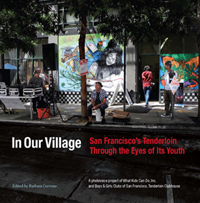 |
IN OUR VILLAGE: SAN FRANCISCO'S TENDERLOIN THROUGH THE EYES OF ITS YOUTH In San Francisco’s Tenderloin district, everyone has a story to tell. Long home to the city’s homeless and mentally ill, the Tenderloin also pulses with immigrants upended by turmoil in their native country. Here, among the single-occupancy hotels, a family of five can squeeze into two small rooms and make a fresh start. This is the poorest and most densely packed neighborhood in San Francisco. It also has the highest concentration of children under 18 anywhere in the city. In this new book from WKCD and Next Generation Press, youth from the neighborhood share their stories. All members in the Tenderloin Clubhouse at Boys & Girls Clubs of San Francisco (BGCSF), they provide a vivid portrait of growing up in a neighborhood many shun. Their photographs and words will open your eyes and hearts. Read more. Order a copy. Flip through book online.
|
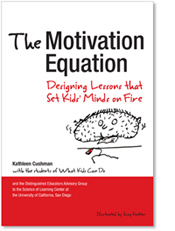 |
THE MOTIVATION EQUATION:
Designing Lessons that Set Kids’ Minds on Fire Teachers kept asking for more after our highly praised book Fires in the Mind recruited adolescents to investigate “the paths to passionate pursuit of something worthwhile” (Howard Gardner). Now comes the follow-up: a lively and discerning multi-media e-book that uses the actual work of teachers, the feedback of students, and the commentary of learning scientists to describe how — and why — high motivation and academic mastery develop in the classroom. Guided by an “actual adolescent brain” named Ned Cephalus and his pithy “Gr8 8” checklist for how youth learn, readers listen in as six case studies of highly effective curriculum and instruction unfold in diverse middle- and high-school settings. Throughout the book, readers use the research-based “Motivation Equation” to analyze what draws students into a learning challenge, helps them persist through difficulties, and brings them to mastery. To read in any browser, go to nextgenpress.creatavist.com. Read it on the iPad and iPhone! Download our free Next Generation Press app here.
|
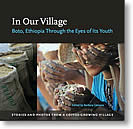 |
Boto, Ethiopia Through the Eyes of Its Youth Few residents of Boto, a farming village in the highlands of southwestern Ethiopia, have traveled farther than their feet can carry them. But their coffee circles the globe. In a place where kerosene lanterns still light the night and children walk dirt paths to fetch water each day, the annual coffee harvest spells ballast or bounty.In this inspiring book, the youth of Boto bring us inside their village, with photographs and stories they have gathered themselves. They have much to say, about the importance of family and community. They have much to teach, about resilience and dreams in the face of breathtaking hardship. |
||||||||
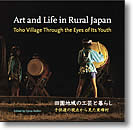 |
ART AND LIFE IN RURAL JAPAN: Toho Village Through the Eyes of Its Youth In a remote mountain village called Toho, unknown to most in urbanized Japan, an unlikely group—the local children—has published a book to open the eyes of the world. Art and Life in Rural Japan presents a vivid portrait of life in depopulating Japan through the eyes of its youngest residents. In stunning photographs and simple first-person narrative (presented in both English and Japanese), the children of Toho make clear that they would like to stay there forever. The book is a treasure of local history, plus describes in loving detail the work of the village’s potters, daily life, celebrations and so much more. SOFTCOVER: |
||||||||
|
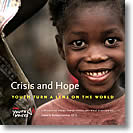
CRISIS AND HOPE: Youth Turn a Lens on the World Written in Chinese or Japanese, the word “crisis?consists of two characters: one representing crisis or danger, the other representing hope or opportunity. In the spring of 2009, WKCD invited youth worldwide to show us, through their own eyes, what troubles them and gives them hope in their close-by world—whether a deeply etched slum in East Africa or a well-off suburb in the northwestern United States. Across four continents and sixteen countries, young people responded to our call by sending their photos and captions—crisp, light, dark. This volume gathers their acute perspectives into a compelling whole. (September 2010 |
||||||||
|
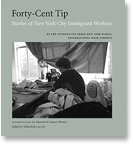
FORTY-CENT TIP: Stories of New York City Immigrant Workers In these extraordinary black-and-white photographs and essays, students new to America present first-person stories of the working lives of immigrants from their New York City neighborhoods. A research project at three small high schools for newcomers in Brooklyn, Manhattan, and Queens, it evokes enormous respect for both youth and adults who arrive here to start new lives with little but courage and grit. (February 2006) |
||||||||
|
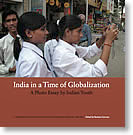
INDIA IN A TIME OF GLOBALIZATION: A Photo Essay by Indian Youth "How do you make the camera snap?” asked 14-year-old Prakash, a student at Government High School-Cotton Pet in Bangalore. Over the next several months, Prakash and his classmates in Bangalore, along with some 30 youth in New Delhi, took close to 5,000 photographs capturing daily life around them. They also gathered over 50 interviews. India in a Time of Globalization provides a unique window into the push and pull Indians face as their country becomes a global power. (April 2008) |
||||||||
|
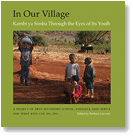
IN OUR VILLAGE: Kambi ya Simba Through the Eyes of Its Youth The rural village of Kambi ya Simba, near the famed Serengeti Plains, is among the world’s poorest; with no electricity or running water, families eke a living from the soil. Students at its secondary school went out with digital cameras and notepads to document daily village life in this remarkable book. Their images and stories speak of resilience as much as hardship, and surprises fill every page. (July 2006) |
||||||||
|
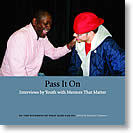
PASS IT ON: Interviews by Youth with Mentors That Matter You don’t have to call yourself a mentor to pass it on ... In this inspiring book of interviews and photographs, youth honor the ordinary adults who reach out to them in everyday but extraordinary ways. Their national “Mentors that Matter” project shows the profound effects on both teenagers and adults when all kinds of people—not just parents and teachers—take time to connect, converse, and care about young people. (April 2008) |
||||||||
|
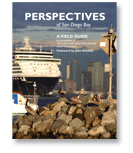
PERSPECTIVES OF SAN DIEGO BAY: A Field Guide Noted environmentalists are giving top honors to this naturalist’s guide to San Diego’s intertidal zones and harbors, which was written and produced by eleventh-grade science, math, and humanities classes at a public charter school. The book identifies and analyzes life forms of the Bay, illustrating with stunning color photographs, maps, and charts. In the tradition of the explorer’s log, students also reflect on nature, civilization, and what the future holds. (January 2006) |
|
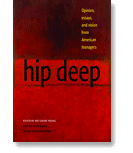
HIP DEEP: Opinion, Essays, and Vision from American Teenagers This groundbreaking anthology presents the freshest young writers and thinkers—age 19 and under—on important issues of our time. From ethnic relations to individual identity, international politics to voting rights, divorce to gay marriage, standardized testing to popular culture, these authors tackle the subjects they care about most. Hip Deep collects its youth voices from many sources: editorials, radio journals, essays, commentary, spoken word, web articles, and more. (April 2006) |
||||
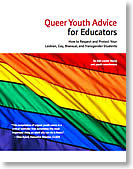 |
Queer Youth Advice for Educators: How to Respect and Protect Your Lesbian, Gay, Bisexual and Transgender Students What adult behaviors help LGBT youth maintain their safety and self esteem? How do teachers help them to grow, or threaten their learning? How can educators learn from the bullying experiences they have endured? Calling on the compelling voices of students themselves, Queer Youth Advice for Educators, by Abe Louise Young, offers concrete and possibly life-saving tips for all adults who are ready to provide lesbian, gay, bisexual, and transgender youth with a supportive and equitable learning environment. |
||||
|
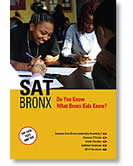
SAT BRONX: DO You Know What Bronx Kids Know? What do inner-city teenagers know that the rest of us may not? What can they do that others might find daunting? What can we all learn, from thinking through the issues that confront urban youth? SAT Bronx aims to find out, by framing the words and experiences of fourteen Bronx high school students in the form of standardized test passages. To answer its multiple-choice questions (co-constructed with two of the students’ teachers and with Kathleen Cushman of What Kids Can Do), one must analyze complex matters of culture, language, behavior, even governmental policy. Taking SAT Bronx opens important conversations about multiculturalism equity, and the assumptions that underlie our thinking about urban youth. (May 2008) |
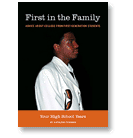
FIRST IN THE FAMILY: Advice About College from First-Generation Students, Your High School Years "If we can do it, so can you!" That's the message sent to students in this advice book, written with college students who were the first in their families to go past high school. It's tough to aim for college if other family members have not—so this book offers the kind of encouraging, practical guidance that an older sibling would give. Inspiring stories of the diverse student contributors—who end up at institutions from community colleges to elite universities—combine with warm and well-organized counsel and checklists. (August 2005). NOTE: We are no longer able to fulfill orders for a single copy or for quantities of less than 50. However, we can fulfill bulk orders for 50 or more books. We have produced a free, updated e-book version that includes videos and multimedia from our First in the Family campaign. Click here to learn more, place a bulk order, view e-book. |
|
|
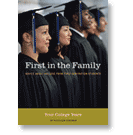
FIRST IN THE FAMILY: Advice About College from First-Generation Students, Your College Years So you’ve been accepted to college, the first in your family to go! Right away, you’ll need this crucial companion volume to the popular First in the Family: Your High School Years. In the words of the same college students who gave their advice earlier, this next-step guidebook tells students how to persist in college—an even bigger challenge for those who are blazing new trails. It offers the peer counsel and well-organized checklists that have made the first volume a hot property in guidance offices nationwide. (September 2006) NOTE: We are no longer able to fulfill orders for a single copy or for quantities of less than 50. However, we can fulfill bulk orders for 50 or more books. We have produced a free, updated e-book version that includes videos and multimedia from our First in the Family campaign. Click here to learn more, place a bulk order, view e-book.
|
|
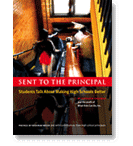
SENT TO THE PRINCIPAL: Students Talk About Making High School Better We often think of adults as investing their time, ideas, and money in making schools better. If we took students equally seriously as investors, we might realize greater rewards: increased motivation, better communication, a more welcoming environment, and improved learning outcomes. How can school leaders make students allies in improving their schools? In this book, students offer some compelling answers. (August 2005) |
|||
|
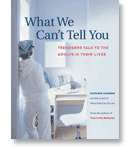
WHAT WE CAN'T TELL YOU: Teenagers Talk to the Adults in Their Lives (Out of Print) Most teenagers don't talk much to adults—but they think about them a lot. So what's on their minds when they shrug off parents' questions with those one-word responses? How can adults best reach out to kids, understand them, and offer them the help they need? In this unusual advice book, teenagers nationwide give their answers. (May 2005) |